
Our services
Request an appointment
Reserve your spot with our medical team in just minutes.
Fascia Grafting in Rhinoplasty in Jaipur | Advanced Soft Tissue Camouflage by Dr. Sushrut Kalra
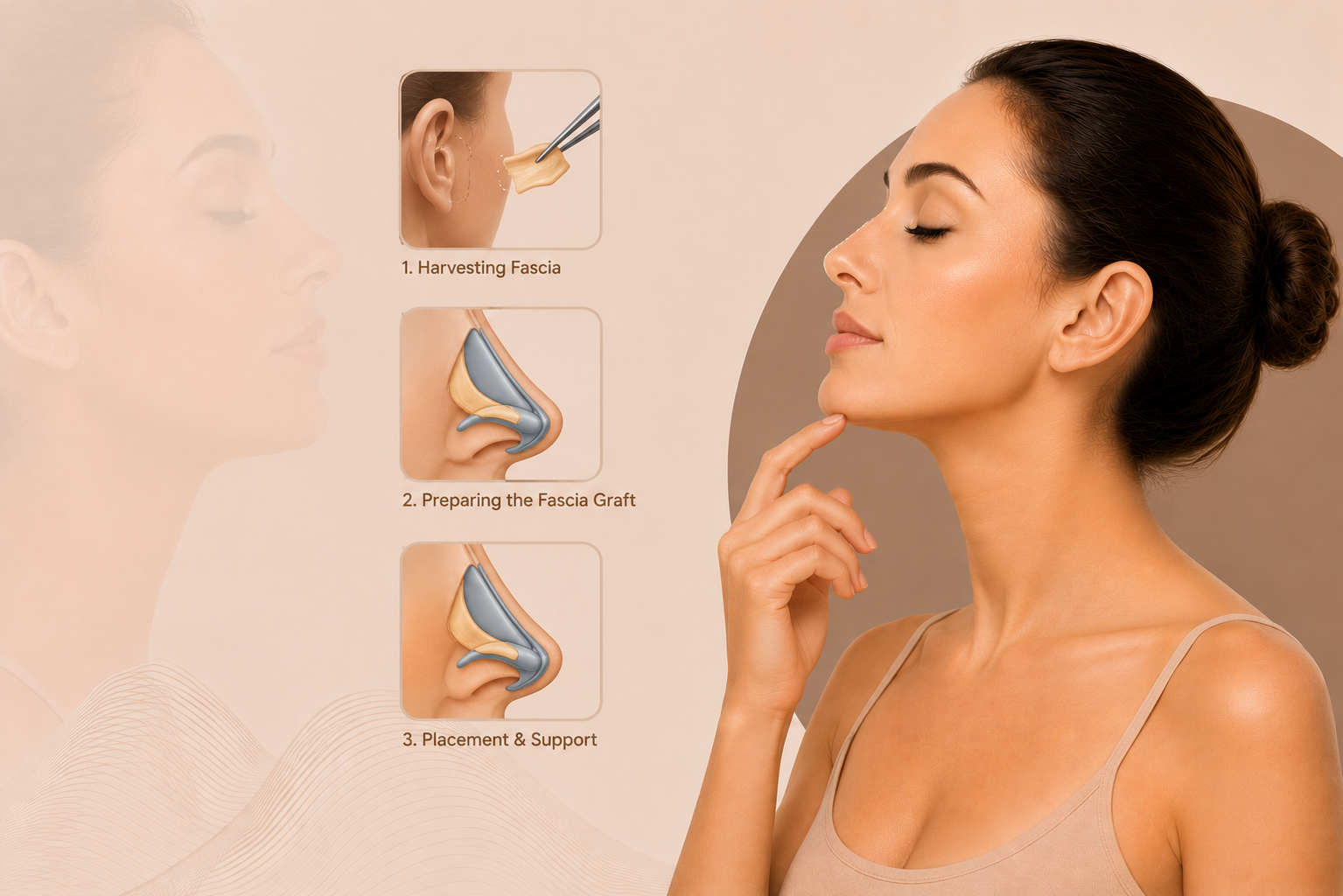
Fascia grafting in rhinoplasty is an advanced technique that uses a thin layer of your own connective tissue, usually taken from the temple, to cover and smooth the structural framework of the nose. In patients with thinner nasal skin, cartilage alone can sometimes show through slightly over time. Fascia helps prevent this by acting as a soft, natural buffer.
Dr. Sushrut Kalra offers advanced fascia grafting in rhinoplasty in Jaipur, using your own tissue to cushion cartilage grafts and create smoother, more natural looking results, without the risks that can come with synthetic materials.
When Fascia Grafting Is Used in Nose Reconstruction
-
Diced Cartilage in Fascia Technique Instead of using a solid piece of cartilage, which can sometimes warp, finely diced cartilage is wrapped in fascia and placed along the bridge for a smoother, more stable result.
-
Camouflage for Thin Skin Acts as a protective layer for patients with thinner nasal skin, helping to prevent any minor irregularities in the cartilage underneath from becoming visible.
-
Revision Rhinoplasty Support Helps rebuild soft tissue volume in noses that have been affected by scarring or previous surgery, providing a healthier tissue layer over the reconstructed area.
-
Softening the Nasal Tip Provides a gentle cushion over tip grafts, helping the tip look natural and soft rather than sharp or overly defined.
-
Safe Tissue Harvesting Fascia is taken through a small, hidden incision in the hair bearing area of the temple, without affecting hair growth or leaving a visible scar.
-
Natural Tissue Integration Since fascia is your own tissue, it integrates well with the surrounding area with a very low risk of complications.
Frequently Asked Questions
It's a technique that uses your own connective tissue to wrap cartilage grafts or cover thin skin, helping create a smoother, more natural nasal contour and reducing the chance of visible irregularities.
It's typically taken from the temple through a small incision hidden within the hairline, which heals without affecting hair growth.
This involves wrapping small pieces of cartilage in fascia before placing them along the nasal bridge, offering a smoother and more stable alternative to a single solid graft.
No, it's mainly used for patients with thinner skin, those having revision surgery, or cases requiring more structural bridge work.
It may reduce slightly in volume during initial healing, but it doesn't dissolve. Once integrated, it becomes a stable part of the nasal structure.
Most patients return to normal activity within 7 to 10 days, once the splint is removed. The final result continues to refine over 12 to 18 months.